Circulation production
Efficiency and Quality in Harmony
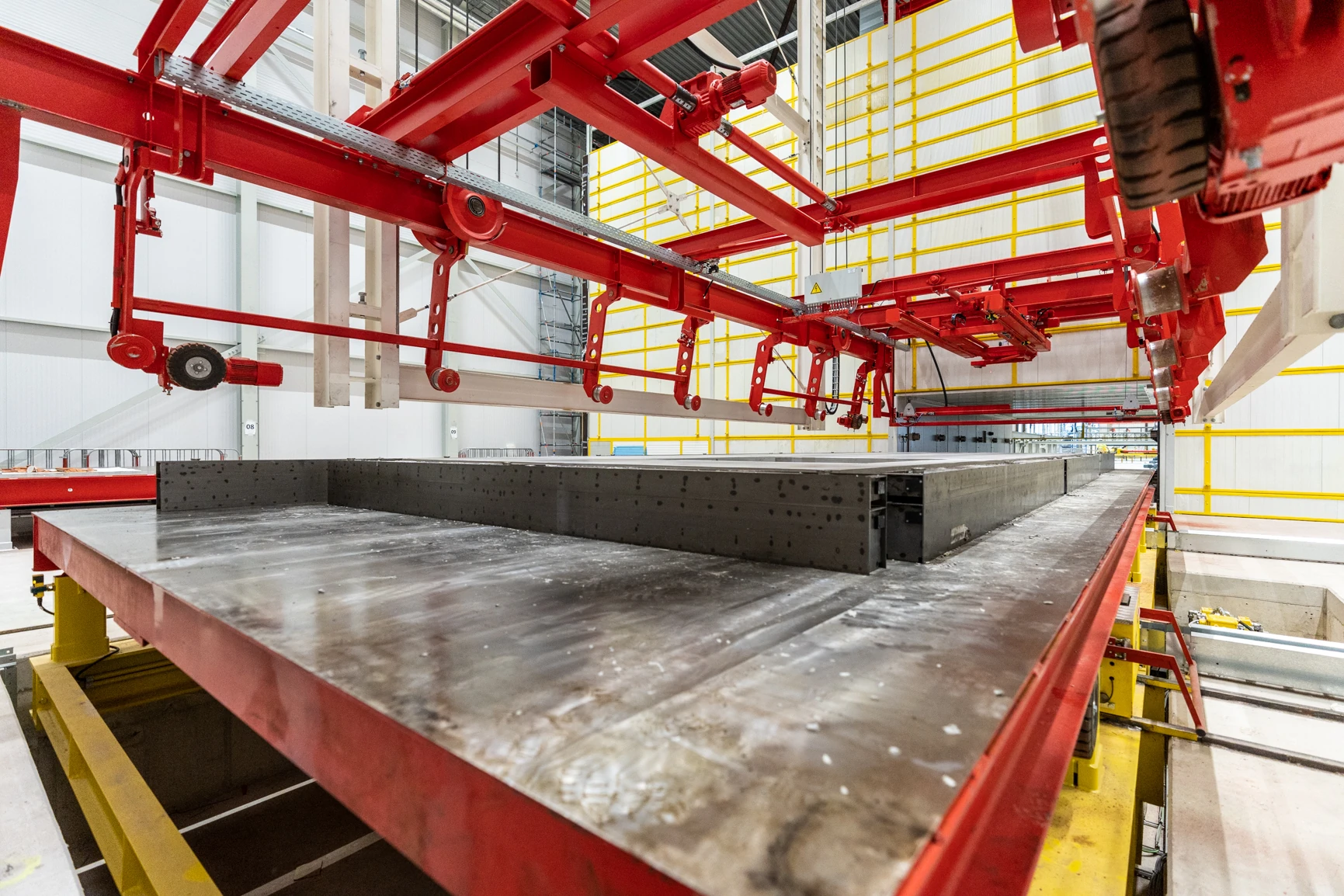
The backbone of modern prefabrication: Components move on tables through the production line, while specialized workstations carry out each step with high efficiency.
Classification
The cycle determines the rhythm of the system.
In continuous production, the production tables move through the plant—from station to station. Each station is specialized for a single production step: forming, reinforcing, concrete placement, compaction, and curing. The result is short cycle times, high repeatability, and maximum productivity—for standardized elements produced in large quantities.
The transition to continuous production doesn’t have to be fully automated right away: Many companies start with manually operated stations and a manageable initial investment. The key is that the system is designed for expansion from the start—so you can automate individual stations as soon as demand grows or competition requires it.
Challenges and Solutions
When cycle time and quality must both be right.
What Causes Friction in Flow Manufacturing
- Machines and systems do not consistently communicate with one another
- Material flows between stations are monitored and controlled on paper
- Production stoppages at one station slow down the entire plant
- Quality inspections on paper increase the error rate at high cycle rates
- At purely manual workstations, the flood of information costs time and efficiency
- The wide variety of variants makes end-to-end automation difficult
What One Prefab Can Do for You
- Centralized, manufacturer-independent control of all machines and components
- Automated material flows instead of manual transfers
- Early detection of bottlenecks before the plant comes to a standstill
- Digital, seamless quality assurance, even at high throughput
- Production plans are broken down into clear, easy-to-understand work steps for each station
- New products and routes can be flexibly integrated into existing lines


Typical Products
What Cycle Manufacturing Is Particularly Well-Suited For
Semi-finished wall and ceiling systems
Openwork ceilings, double walls, balconies
Solid-slab Ceiling and Wall Systems
Fully finished solid components
Insulated Sandwich Walls
With or without a clinker brick facade
Modular Manufacturing with an Expansion Line
Housing Modules and Garage Concepts
Benefits at a Glance
The Benefits of Batch Production with One Prefab
- High throughput with consistent quality
- Shorter cycle times thanks to specialized workstations
- Scalable from partial automation to a fully networked system
- Reduced staffing requirements through automated processes
- Digital transparency even at stations operated entirely manually