In-house manufacturing
Custom Precision for Complex Components
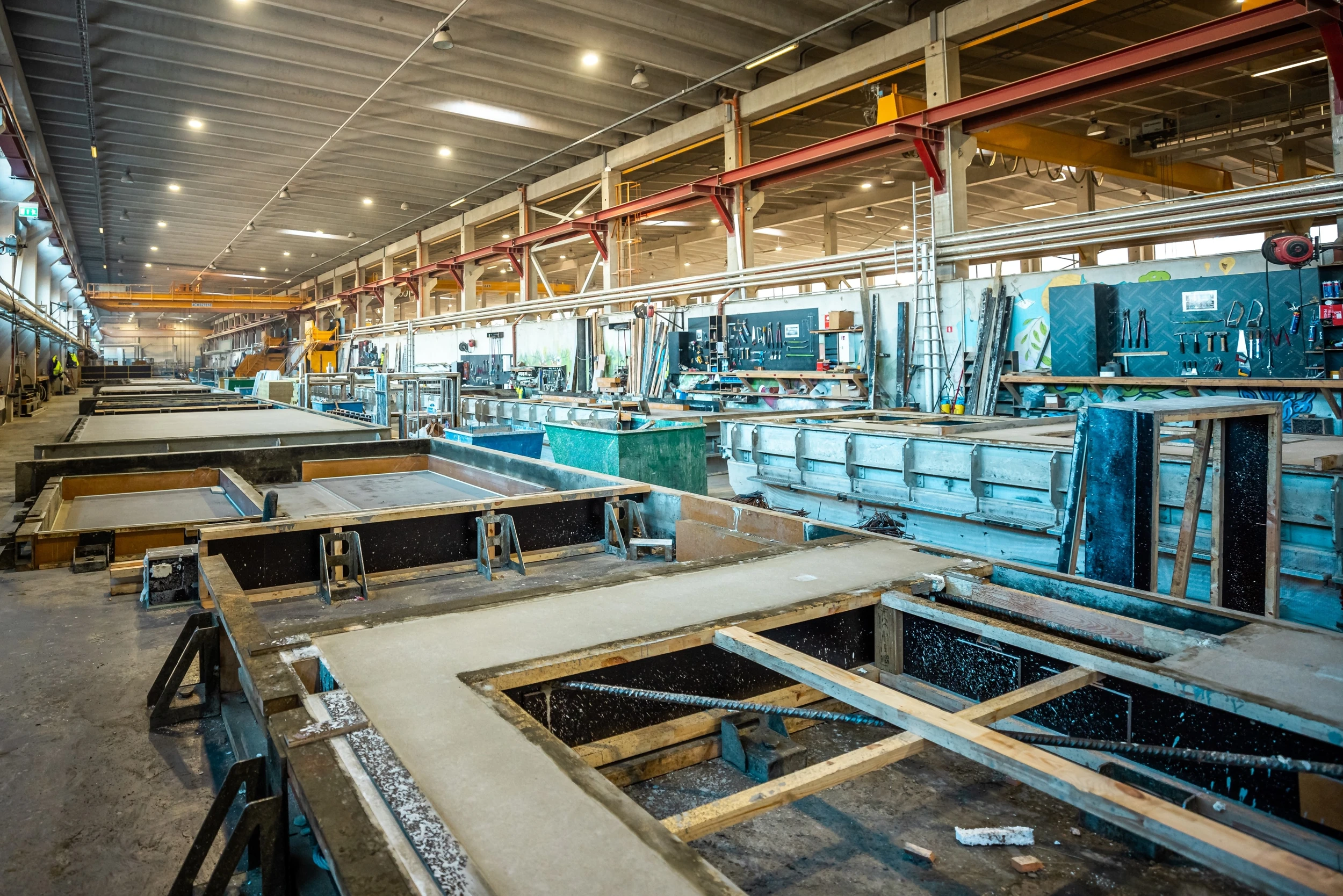
Maximum flexibility for custom components: In stationary manufacturing, a part is produced entirely in one location—on tables, conveyor belts, or in molds.
Classification
One place. All the steps.
In stationary production, the component remains in a fixed location throughout the entire production process. Formwork, reinforcement, concrete placement, curing, and formwork removal all take place at the same location—it is not the component that moves through the plant, but rather the production steps that come to it. This production method is the right choice when components are manufactured individually, are complex, or are produced in small quantities.
In this context, “stationary” does not necessarily mean “manual”: Especially with long production lines, the machine operates automatically—it moves toward the component rather than the component moving through the system. Manual and automated stationary production differ in their degree of automation, not in their basic principle.
Challenges and Solutions
When every component is different, but the control system remains the same.
What Causes Friction in In-Plant Manufacturing
- Significant coordination effort between the design and manufacturing departments for custom components
- Varying requirements for each order make it difficult to maintain consistent control
- Manually documenting tests and approvals takes time
- It is difficult to plan the workload of individual stations due to varying levels of complexity
- Knowledge about custom solutions remains with individual employees rather than in the system
What One Prefab Can Do for You
- Digital job and drawing data available directly at the workstation
- Flexible work steps and inspection criteria for each element, rather than rigid standard processes
- Complete documentation, even as requirements change
- Predictable Ward Occupancy Despite a Wide Range of Variations
- Transparency of Custom Solutions for the Entire Team
Typical Products
What In-Plant Manufacturing Is Particularly Well-Suited For
Precast Structural Elements
These include columns, trusses, balconies, and stairs.
Prestressed Ceiling and Wall Systems
Prestressed concrete hollow-core slabs, as well as solid and sandwich walls for custom building systems
Prototypes and project-based small-batch production
Prefabricated components with a high degree of customization, manufactured specifically for a customer project.
Benefits at a Glance
The Benefits of On-Site Manufacturing with One Prefab
- Maximum flexibility for custom components and small production runs
- Digital Traceability Despite Changing Requirements
- High dimensional accuracy and quality, even with complex geometries
- Lower investment costs compared to fully automated systems